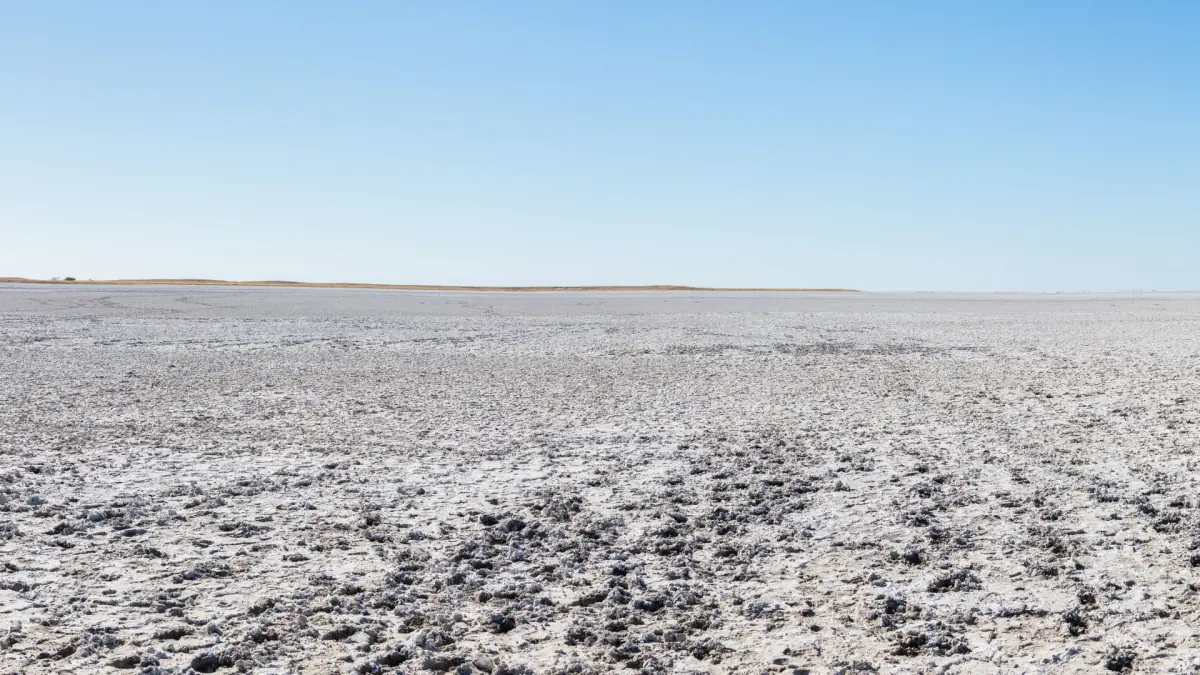
Ntwetwe Pan, also written Nwetwe Pan
Ntwetwe Pan is the large salt pan in the west of the Makgadikgadi complex, lying west of Sowa Pan. Official Botswana Tourism pages spell it Ntwetwe. Many travellers search for Nwetwe Pan, which is only a spelling variant and not a different pan. The surface is flat, pale and almost without vegetation, and it looks very different when the summer rains have flooded it.
For the wider picture of Sowa, Kubu Island and the other pans, read the salt pans guide.

A night on Ntwetwe Pan
This sleep-out spends an evening and a night on the salt flats, departing from the Kasane area.
Hand-picked tours, booked through GetYourGuide. Prices are indicative starting prices in US dollars (as of October 2026). Tap a tour for live availability and the current price in your currency.

Overnight trip onto Ntwetwe Pan
A guided night on the salt, starting from Kasane. Check the pickup points and what is included before you book.
What a night on Ntwetwe involves
Operators describe sleep-outs on the pan as nights in open beds under the sky, with the programme depending on the weather. The overnight listed here picks guests up in Kasane, Kazungula and Lesoma. It names dinner, breakfast, camping equipment without a tent and drinks, and it needs at least four participants. Meerkats appear only as a possible sighting on the way, never as a promise.
Which plot the trip uses overnight, and under which concession or community title, is not given in the listing. So do not assume that every point on the pan is open camping ground.
Plan for the heat and the glare. The CDC advises drinking enough water, using sun protection and suitable clothing, and adjusting activity in hot weather. The pan has almost no shade, so ask the operator what shelter and water are provided on the night.
Where the national park ends
The Makgadikgadi National Park covers only the western end of Ntwetwe and the grassland towards the Boteti River. The rest of the pan lies outside it, and the park page explains fees and access. Quad rides on the pans are guided activities of some operators and one operator calls them a dry-season option. They give no right to ride privately. Before you drive on the pan yourself, read the self-drive guide, because a small amount of rain can stop a crossing.
The same caution applies to the surface itself. A crust that looks dry is no guarantee that it will carry a vehicle, and a deep crossing needs a current go-ahead for that day and not just a season calendar. Local advice is to carry recovery equipment, spare fuel and water and to stay with the vehicle if it breaks down. In remote areas the FCDO suggests emergency supplies and, in very remote regions, a convoy or a satellite phone, because a phone signal and a GPS app are not a rescue plan.
Wildlife and health points matter on the salt too. The CDC lists parts of the Boteti area among the malaria transmission zones, so the pans should not be treated as malaria free, and a travel clinic can advise on prophylaxis. Operators warn against feeding or disturbing animals and note that some camps are unfenced. The FCDO also advises against swimming in rivers and lakes because of wildlife and waterborne disease.
Ntwetwe Pan questions
Is Nwetwe Pan a different place?
No. Nwetwe is a common spelling of Ntwetwe, the large pan west of Sowa.
Can I camp freely on the pan?
No. Nights on the salt are organised activities, and a general camping permit for every point is not documented.
When is the best time to visit Ntwetwe Pan?
It depends on what you want. Dry pans suit nights on the surface, while rain brings animals to the grassland but can close the pan. See the season guide.
Can I ride a quad on Ntwetwe Pan?
Only as a guided activity of an operator that offers it. One operator describes pan quad rides as a dry-season activity, while another operator forbids quads in its park rules. That gives no right to ride privately, so ask the operator what applies where you are.
Is the whole of Ntwetwe Pan inside the national park?
No. The park covers only the western end of the pan and the grassland towards the Boteti. Most of the pan lies outside it, and each area can have its own rules and fees.